1. Introduction and Stakeholders
Sokoban is a puzzle video game where a player controls a character called the Sokoban on a 2D map viewed from above. The map consists of wall and floor squares as well as boxes and marked storage locations. The goal in each level is to push all boxes on the map to marked storage locations. The Sokoban can move across floor tiles horizontally and vertically and push, but not pull boxes by “walking” against them. This only works, if the square behind the box is an empty floor tile, i.e. not a wall nor another box.
Our customer Hawki employed us to create a distributed Sokoban game, that can be played in both single and multiplayer modes.
Main features of the distributed Sokoban game
Client-Server architecture: clients can connect to the game server, that manages all connected clients.
Sokoban Game Engine: is server-side and implements the core game logic and thus features like player movements, game board related operations and updates of the authoritative game state.
Different game modes: our Sokoban features a single player mode and two different multiplayer modes (cooperative and competitive)
Power-ups and -downs: the Sokoban game boards feature different power-ups and downs like increased/decreased movement speed or the ability to pass through walls, to make the game entertaining and versatile
AI Assistance: players can toggle AI assistance during game sessions, if they are stuck on the current puzzle
User and Account Management: players can register and authenicate for the distributed Sokoban game. They are also able to manage their profiles and view player statistics and leaderboards for the ranked multiplayer mode
Map Editor: players can use the map editor to create and share custom Sokoban maps
Community and Social Interaction: players have the option to spectate ongoing multiplayer sessions and exchange in-game chat messages with each other.
Progress and Statistics: players of our game can track their gameplay staticstics and share their scores and achievements
1.1. Stakeholders
1.1.1. Overview
Stakeholder |
Concerns / Expectations |
Importance for System Success |
Influence on Requirements / Project |
|---|---|---|---|
Customer (HAWKI) |
Defines vision and goals, approves all decisions |
Very high |
Very high |
Players / End-Users |
Game must satisfy them feedback affects features |
High |
Medium |
Developers |
Implement the system |
Low |
Medium |
Software Architects |
System design, distributed architecture |
Medium |
High |
System Admins / DevOps |
Uptime, hosting, scaling |
Medium |
Medium |
Cloud / Server Provider |
Required for an always-online game |
High |
Medium |
Level Designers |
Gameplay quality, level design |
Medium–High |
Low–Medium |
QA / Testers |
Ensure quality, avoid regressions |
Medium |
Medium |
IT Security |
Account protection, cheating prevention |
Medium |
Medium |
Support & Helpdesk |
User satisfaction & support |
Medium |
Low |
Community & Moderation Team |
Leaderboards, map moderation |
Medium |
Low |
Project Managers |
Planning & delivery |
Medium |
Medium |
External Software / Asset Suppliers |
Libraries, engines |
Low–Medium |
Low |
Law & Compliance |
Licensing, data protection |
Low–Medium |
Medium |
1.1.2. Importance vs. Influence diagram
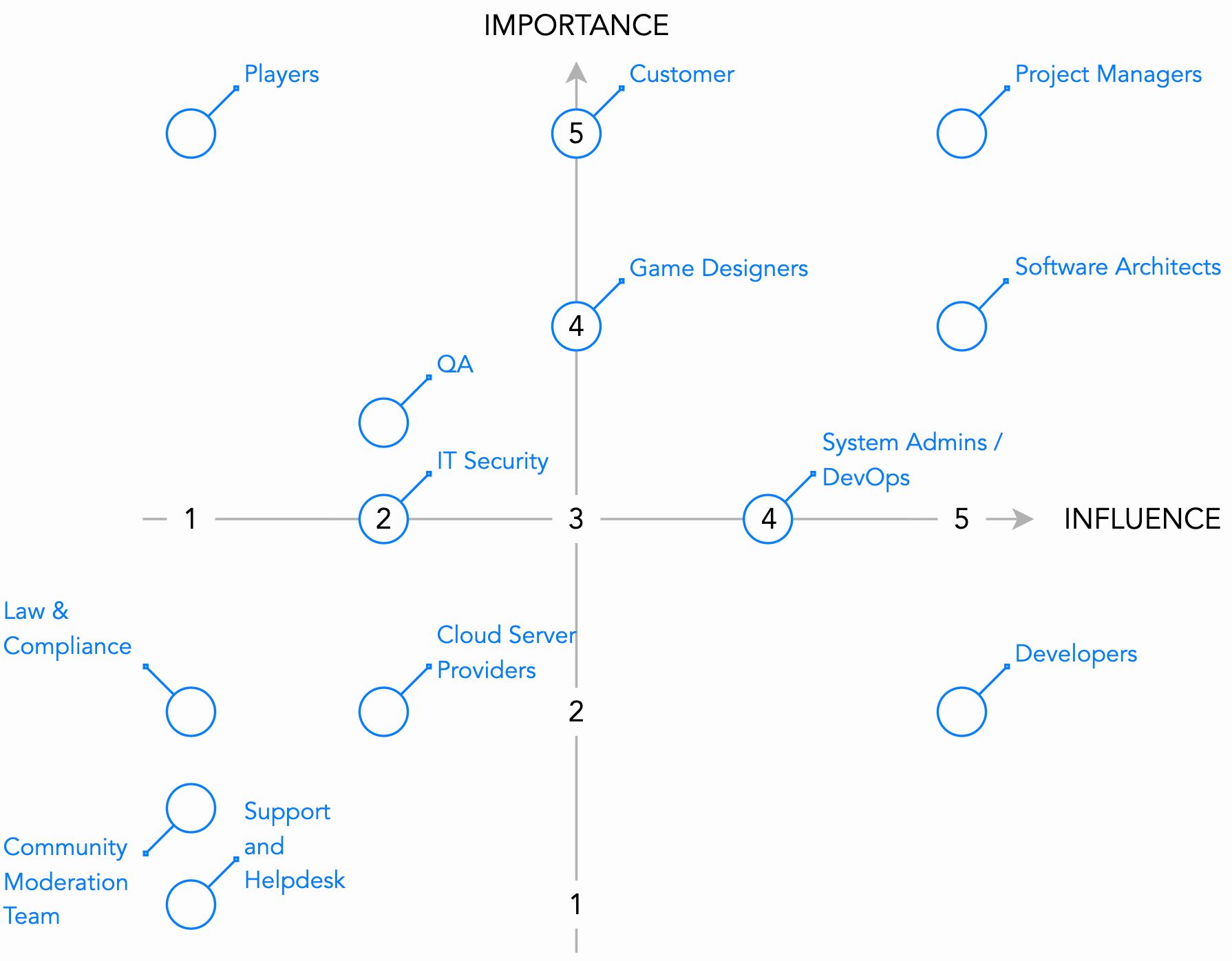
1.1.3. List of Concerns
Customer (HAWKI)
Distributed game with central client-server architecture
Game should follow basic Sokoban rules
Cross-platform client support
AI only assisting, not competing
Always online, stable system
Good user experience and customization
Project stays within a predefined budget
Agreed upon project timeline
ROI expectations
Players/End-Users
Playing a Sokoban game
Fun gameplay, intuitive controls
Stable servers and low latency
Fair matchmaking in ranked mode
Possibility to create, save, and share maps
Ability to spectate friends
Smooth matchmaking and co-op experience
Accessible UI/UX (key bindings, visual aids, color-blind mode)
Community interaction
Developers
Clear and feasible requirements
Clear priorities
Stable technologies (game engines/graphics libraries)
Maintainable codebase
Manageable workload
Software Architects
Scalable client-server architecture
Long term maintainability
Clear session management
Multiplayer synchronization
Secure and fair gameplay
Level Designers
Flexible map editor
Validity checks for solvable maps
Balanced power-ups and power-downs
Clear rules for co-op and time-trial modes
No cluttered game boards in multiplayer
Power-ups and -downs working correctly
Proper tooling support for map creation
QA / Testers
Well-defined scenarios
Testable system design
Bug-free mechanics, especially multiplayer sync
Thorough testing of gameplay features
Monitoring of error rates
Stable and reliable builds
System Admins / DevOps
Server uptime and monitoring
Deployments, updates, backups
Cloud resource management
Cost-efficient infrastructure usage
Cloud / Server Provider
Reliable hosting
Scalable back-end capacity
Defined service-level agreements
Support & Helpdesk
Tools to assist players with login issues, bug reports
Structured issue resolution workflows to solve most problems
Clear error messages from the system
Community & Moderation Team
Manage leaderboards
Approve player-created maps
Moderate chat/interaction channels
Player forum, feedback and a report system
Moderation tools
IT Security
Prevent cheating/tampering
Secure login/authentication
Protect user data
Law & Compliance
Licensing for assets
IP rights handling
Follow local law regarding e.g. censorship
Data protection laws (GDPR, etc.)
TOS and PP
External Suppliers
Provide game assets
Provide compatible libraries
Project Managers
Scope clarity
Timeline management
Stakeholder alignment
Risk management planning
1.1.4. Conflicts
Customer vs. Developers
Customer wants many features (spectator mode, map editor integration, assistive AI, multiplayer sync), which may conflict with development time and complexity
Developing features costs time
→ Group features by importance and release feature updates
Customer vs. Players
Customer wants ROI and thus aggressive monetization
Players want a nice UX and no pay to win
→ Transparency and fair monetization
Customer vs. Software Architects
Customer wants cross-platform clients (desktop/mobile/web/(steam))
→ Architects must ensure portability, which increases design complexity
Players vs. IT Security
Players want full control over map creation & sharing
→ Security must restrict harmful content, cheating, or injection
Level Designers vs. QA Testers
Designers want many power-ups, power-downs, and randomness
→ QA has to maintain predictable, testable behavior
Community & Moderation vs. Players
Players want unrestricted map sharing and have chatrooms
→ Moderation must remove inappropriate maps and content
Support & Helpdesk vs. Developers
Support wants easy debugging information
Developers could expose too much internal info, give too much privileges
→ Also test support tools for functionality and restrict privileges for critical operations
Customer vs. Law & Compliance
Customer wants community features like a chatroom and other interactions
Law & Compliance needs to follow local laws regarding censorship and ager verification
→ use 3rd. party age verification and identification and localize game content